
 Jira · Guide
Cycle time is the total active time an issue spends flowing through your workflow, from the moment work starts on it to the moment it is done. If you want to reduce cycle time in Jira, the instinct is usually to tell everyone to work faster or to add more people. Neither helps much, because most of an issue's cycle time is not spent working. It is spent waiting: sitting in one status, blocked, queued, or forgotten while attention is elsewhere.
The good news is that this waiting is measurable and unevenly distributed. A small number of statuses usually account for most of the delay. This article is a short, practical playbook: find the biggest wait, shrink it, and put a guardrail in place so it does not creep back. You do not need a data team to do this, just a clear view of where issues actually sit.
What cycle time really measures
Cycle time answers one question: once we start an issue, how long until it ships? It is the sum of the time an issue spends in each active status along the way. Lead time is the wider number that includes the backlog wait before work begins; cycle time is the part your team actually controls day to day.
The trap is treating cycle time as a single lump. Averaged across a board, it tells you almost nothing about where to act. Broken down by status, it becomes a map. If In Review holds issues for days while In Progress moves quickly, you know exactly which part of the flow is costing you, and adding developers would do nothing for it. The metric that exposes this is time in status, covered in depth in time in status in Jira.
Active time, not calendar timeWhen you compare cycle times, be consistent about what counts. Some teams measure calendar hours; others strip out weekends and non-working time. Either is fine, as long as you use the same rule everywhere so the comparison between statuses is honest.
Find the biggest status dwell first
The single highest-impact move to reduce cycle time in Jira is to find the status where issues sit longest and shrink that one first. This is straightforward maths: if one status accounts for half of your cycle time, halving the wait there does more than a 10% improvement everywhere else combined. Chasing small gains across every status is effort spread thin.
To find that status you need dwell time, also called status aging: how long each issue has been sitting in its current status right now, and how long issues typically sit there. If that idea is new, what is status aging in Jira explains the mechanism and why issues get stuck. The practical output you want is a ranked view of statuses by how much time issues pile up in each.
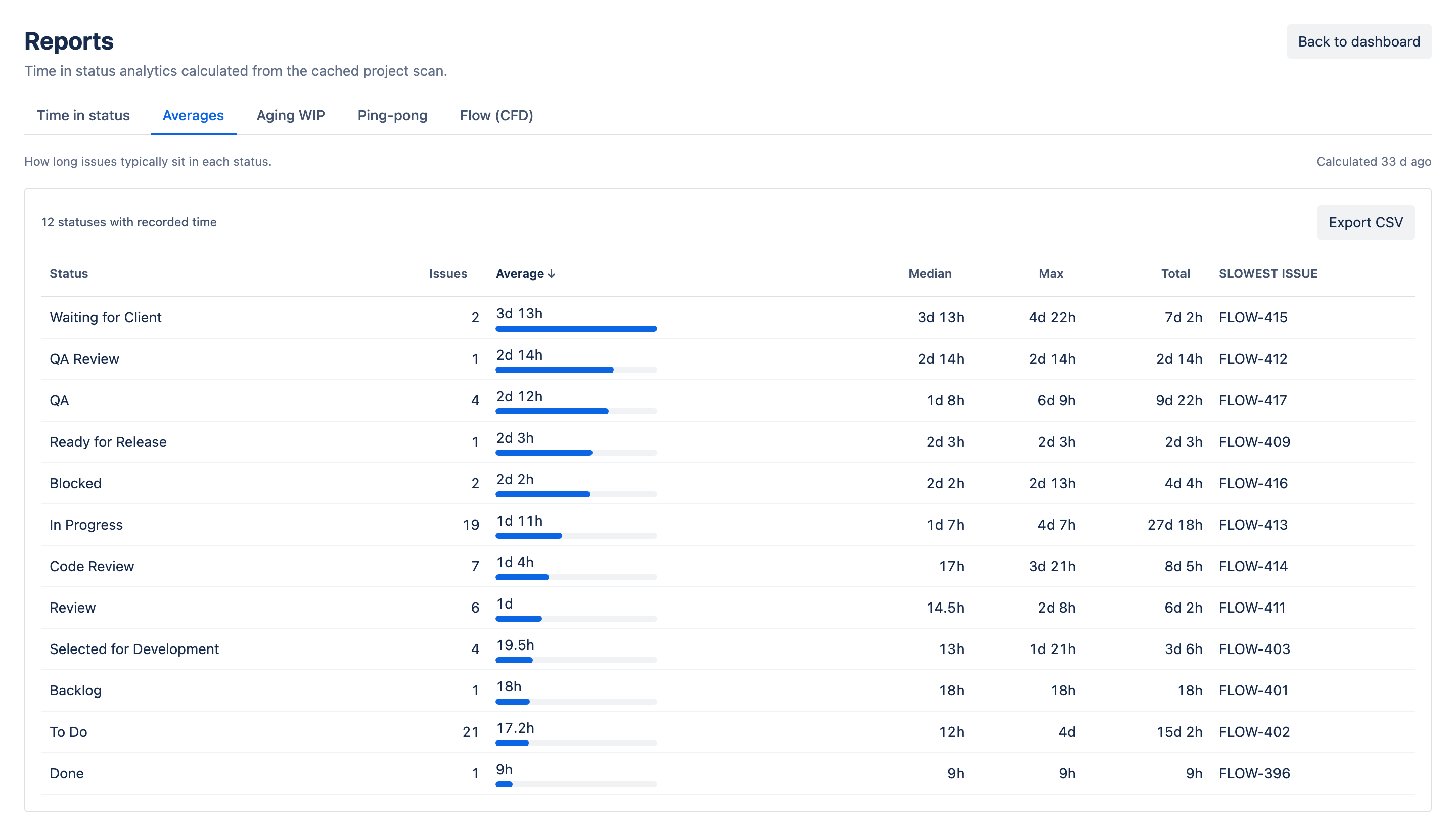
Look at the aged issues clustered in one status and ask why they are there. Usually it is one of a handful of causes, and naming it points straight at the fix.
- A handoff gap — work is done but the next person has not picked it up, so it waits in a queue nobody owns.
- A capacity mismatch — one role (often reviewers or QA) is a narrower gate than the rest of the flow, so a queue forms in front of it.
- Unclear "done" for that status — people are unsure whether an issue is ready to move on, so it lingers by default.
- Genuine blockers — a dependency, a question, or an external wait that nobody is actively chasing.
A playbook to reduce cycle time in Jira
Here is the sequence. Run it on one board, prove it works, then repeat. Each step feeds the next, so resist the urge to jump ahead to solutions before you know where the delay actually lives.
- Measure dwell per status. Get time-in-status data and rank statuses by how long issues sit in each. Do not act on averages alone; look at the worst offenders too.
- Pick the single biggest wait. Choose the one status with the largest total or typical dwell. This is your target.
- Name the cause. Read the aged issues in that status and decide which of the causes above is dominant. One usually is.
- Fix that cause directly. Assign an owner to the queue, add review capacity, tighten the exit definition, or start chasing blockers actively — whatever matches the cause you named.
- Limit work in progress. Cap how many issues can sit in the problem status at once so the queue cannot rebuild. Less parallel work almost always means shorter cycle time.
- Alert on aging. Set a threshold per status and get a signal when an issue exceeds it, so the next stuck issue surfaces in hours rather than being discovered at the sprint review.
- Re-measure and move on. Confirm the dwell dropped, then run the same loop on whatever status is now the biggest wait.
Fix one status, then re-rankDo not try to improve every status at once. Fix the biggest dwell, then re-measure — the bottleneck often moves to a new status, and you want to attack the real one, not last month's.
Limit WIP so cycle time stays down
Once you have shrunk the biggest wait, the risk is that it grows back. The most reliable guardrail is limiting work in progress. There is a direct relationship, known as Little's Law, between how much work is in flight and how long each item takes: the more issues open at once, the longer each one's cycle time. Starting fewer things finishes them faster.
In practice, put a cap on the busiest columns and treat hitting the cap as a signal to help finish existing work before pulling in more. This pairs naturally with status aging — a WIP limit stops the queue forming, and an aging threshold catches the issues that slip through anyway. The interplay between WIP limits, aging and service targets is worth reading in full in Jira WIP limits, status aging and SLAs.
You do not reduce cycle time by working faster. You reduce it by starting less, finishing more, and never letting an issue age quietly in a queue.
Alert on aging so it does not recur
The final piece is making the improvement stick without constant manual checking. Set an expected threshold for each status and let an alert fire when an issue ages past it. That turns a bottleneck from something you discover late into something that raises its hand early, while there is still time to act before a deadline slips.
This is where a dedicated tool earns its place. Time in Status — Status Aging Alerts for Jira tracks how long every issue has sat in its current status and flags work that ages past the threshold you set per status — and it can count business hours only, timezone-aware, so weekends never inflate the dwell you are comparing. Instead of eyeballing the board, you get the aged issues surfaced for you, which keeps the dwell you just shrank from creeping back. For the wider habit of catching problems early, see how to find stuck Jira issues before they blow a deadline.
Do this consistently and cycle time stops being a lagging number you report after the fact. It becomes something you steer, one dwell at a time, with the biggest wait always in your sights.